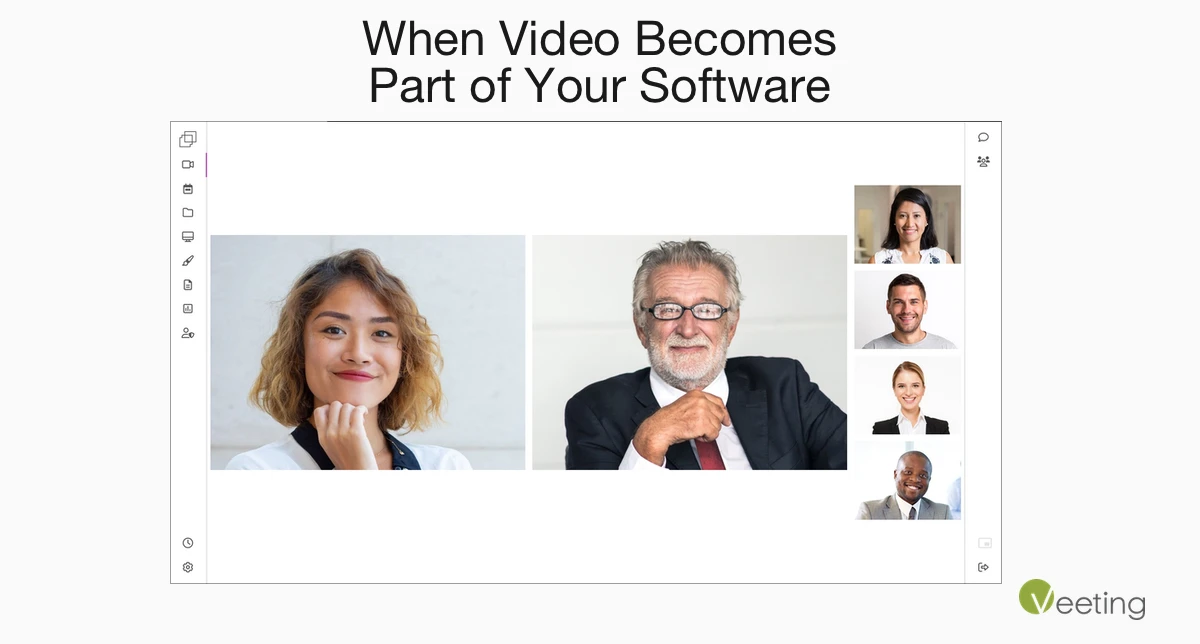
Case Study: When Video Becomes Part of the Software
Digital consultations have become a standard part of many service offerings. In healthcare and beyond, clients increasingly expect appointments to be available online when needed. For software providers, this raises an important question: how can video communication be integrated in a way that feels like a native part of the product instead of an external add-on?
HealthAdvisor Group AG, a leading Swiss provider of practice management software for therapists, faced exactly this challenge. The goal was to extend the existing application with video consultations without introducing additional platforms or complexity. At the same time, operating the solution in Switzerland was an important factor, as it aligns with the location and regulatory environment in which HealthAdvisor itself operates.
Focusing on a Clearly Defined Use Case
In daily practice, therapists use HealthAdvisor to manage appointments, documentation, and billing. The software forms the backbone of their workflow.
The objective was to extend this existing process with a video consultation feature. Sessions needed to be available as online appointments without requiring separate logins or switching to an external platform. Moving from scheduling to video consultation had to feel like a natural continuation of the same workflow.
The goal was not to introduce a standalone meeting platform, but to embed video functionality directly into the existing application experience.
Implementation with Veeting Rooms
To implement this, HealthAdvisor selected Veeting Rooms, a Swiss-developed video solution by Veeting AG. The platform has been developed and operated in Switzerland since 2014 and is designed as a standalone video infrastructure. Through open APIs and an SDK, it can be integrated seamlessly into existing applications.
HealthAdvisor uses these APIs to manage video consultations directly from within its software. Meeting links are automatically generated, displayed in the application, and included in appointment confirmations sent to clients.
Veeting Rooms provides the video infrastructure in the background, while HealthAdvisor retains full control over scheduling and user management within its own system. This allowed the integration to be implemented without major changes to the existing architecture.
Whitelabel as an Extension of the Product
An important aspect of the solution was the ability to offer video consultations under HealthAdvisor’s own brand. Sessions are conducted as “HealthAdvisor Video Call,” with no visible reference to Veeting.
The interface, colors, and navigation are aligned with HealthAdvisor’s existing design. Even the domain reflects the company’s own environment rather than redirecting users to an external platform. For both therapists and clients, the experience appears as a fully integrated solution.
Because users already trust HealthAdvisor as their primary software provider, that trust naturally extends to the video consultation feature.
Collaboration and Local Context
Beyond the technical implementation, the collaboration between the two companies played an important role. Requirements could be aligned directly, and feedback from real-world usage was incorporated quickly. Short decision cycles and direct communication between teams helped streamline the process.
Operating the solution in Swiss data centers, combined with clearly defined contractual responsibilities, provided transparency around data processing and compliance. Both companies operate within the same regulatory environment, which simplified alignment on data protection requirements.
Conclusion: Video as Part of the Product
The HealthAdvisor case shows that video communication in specialized applications does not need to exist as a separate platform. The real value comes from embedding it directly into the product experience.
In this setup, Veeting Rooms acts as the underlying video infrastructure rather than a standalone collaboration tool. This allows software providers to offer digital services under their own brand without building and operating a video platform themselves.
Read more: Veeting Rooms for healthcare and embedding video with Veeting Blocks.
